

There’s a familiar pattern and response every time Barcelona concedes a goal. The ball is played behind, with runners coming from deep and the defence is caught high. And almost immediately, everyone calls Barcelona’s high line the problem.
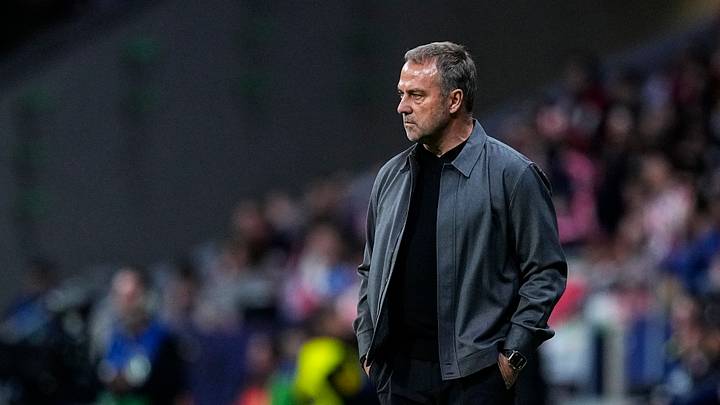
Especially after Barcelona were knocked out of the UCL quarter-finals against Atletico, people have been very critical of Hansi Flick’s system and philosophy. It’s easy to blame the high line, but the moment the ball is played behind, the real damage has already been done.
Pundits have been calling for deeper defending since day one and have stated again and again that the high line would not work against tougher opposition. The system has worked multiple times against the likes of Real Madrid and Bayern Munich, but have also suffered against more physical sides like Atletico Madrid in the recent Champions League tie.
There is a dilemma with this system. When Barcelona’s philosophy of high line works, it looks like the best way to play football. And when it doesn’t, it looks like a high-risk and clumsy way to play football.

Why everyone gets it wrong?
Barcelona’s high line has become a scapegoat for every time Barcelona concedes a goal. But it is important to remember that focusing solely on the high line itself is the problem.
The high line of Barcelona doesn’t exist on its own, but it is a structural philosophy of clever spacing, positioning, and work rate. Failing to perform in any of the three causes Barcelona’s high line to suffer.
To understand it better, it’s important to understand what happens before Barcelona gets exposed. It generally starts with Barcelona losing the ball in possession or in transition. The opponent plays the ball behind, and Barcelona’s defenders quickly have to move forward in a straight line to force the attackers of the opposition into the offside trap.
But when the defenders are in this process, the opposition players at this exact moment make deeper runs, which break the offside trap, and they get through on goal. Players with excessive pace do not even need to make deeper runs, and they can just wait for the right ball and make runs in behind.
At this moment, the high line gets the blame, but it is just a piece of the chain. The real problems lie in the press and positioning of the team, especially the midfield and the frontline.

Pressure and positioning are the real problems.
For the proper functioning of a high defensive line, clever pressure and positioning are pivotal. If a player on the ball is under pressure, their options get limited, their passes become less accurate and rushed.
When this happens, the high line gets very advantageous as it eliminates space for the opposition and allows quick recovery of the ball, and puts Barcelona’s attackers in very good positions for dangerous counter-attacks.
For this to happen, the entire team must press and position themselves as a unit. A high line requires clever and precise movement and positioning from the players. Even if one player breaks the chain, the entire structure can fall apart.
If one player steps forward, while another hesitates, and even timing errors can create gaps, which the opponents can exploit. But when pressure and positioning disappear due to lack of concentration or fatigue, the opposition players can execute passes very easily that bypass the entire structure. Again, this is not the flaw of the system but of the execution.
Another aspect is the space between the midfield and the defence. Barcelona needs to maintain compactness in order to decrease the space for the opposition to exploit. The spaces must be minimal.
The midfield must support the defensive line, and attackers must press the opposition defenders while being compact enough to maintain the shape. When Barcelona loses compactness, the distance between the lines increases, and pockets of space emerge, which the opposition can exploit and move the ball forward.

Dropping deep is not the solution.
When Barcelona concedes goals, the common reaction from the public and pundits alike is to blame the high line and suggest dropping deeper. Dropping deeper means changing the system completely. No quick recoveries and no quick transitions.
Hansi Flick’s philosophy involves recovering the ball as soon as possible and making attacking involvement for the majority of the match. Barcelona has never been a good defensive unit, and dropping deeper invites pressure from the opposition and takes away the control of the game.
The real solution is not dropping deep but to improve the intensity and positioning of the press and effective coordination among the backline. For this to be maintained, Barcelona needs to manage discipline and fatigue especially in the more demanding games.
Barcelona must learn their lessons after this season’s painful quarter-final exit at the hands of Atletico de Madrid, where they couldn’t maintain the same energy and intensity in the second half of the game. Barcelona couldn’t cope with their physicality, their set-piece ability and better game management.
Conclusion
Barcelona’s high line is a representation of Hansi Flick's philosophy of how the team wants to play, which is by being the protagonist with the ball.
Barcelona’s strength lies in quick transitions and attack. The high line provides a structure that enables them to play their natural game. No system is perfect, and every system has problems. Barcelona knows exactly how to fix the problems, be it the structure, game management, proper discipline or clever positioning.
Has Barcelona figured it all out? No. Will they ever figure it? We hope so.
 Add us as a preferred source on Google