

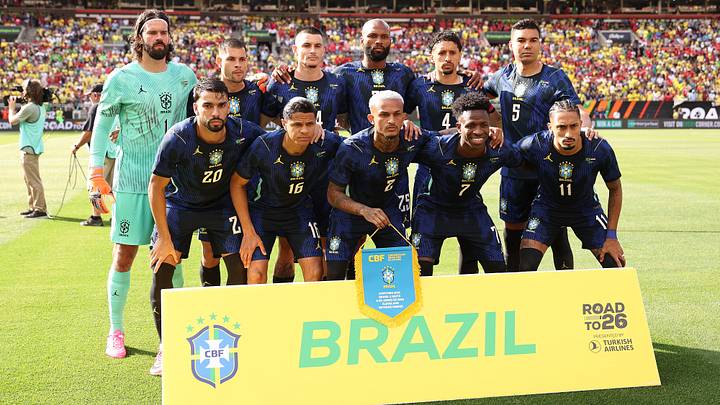
On the eve of Brazil's World Cup opener, Carlo Ancelotti is facing a high-stakes tactical puzzle. The devastating injury to rising star Wesley during their final warm-up game against Egypt has seen all of the manager's defensive plans go out of the window. This means that a big change in the Selecao's formation is on the cards.
In order to protect a fragile defence and yet make the most of an abundance of attacking talent, Brazil will most probably switch to a strong 4-4-2 formation, which puts the entire weight of responsibility on the shoulders of Barcelona's Raphinha.
The strongest Brazil starting XI
In order to try and find the best tactical discipline, the strong 4-4-2 formation should looks exactly like this:
Goalkeeper: Alisson
Defenders: Danilo (RB), Marquinhos (CB), Gabriel Magalhes (CB), Douglas Santos (LB)
Midfielders: Raphinha (RM), Casemiro (CDM), Bruno Guimares (CDM), Lucas Paquet (LM)
Forwards: Vincius Junior (CF), Igor Thiago (ST)
The fullback crisis: Danilo comes in for injured Wesley
With Wesley out with an injury, this tournament, Brazil have lost the natural, modern, attacking fullback, which means that defensive solidity will have to take precedence over attacking wingbacks.
Alisson remains the guaranteed choice between the sticks, and he will be a great source of experience and stability in goal. In front of Alisson are the centre-back pairing of Marquinhos and Gabriel Magalhes, a very balanced, aggressive centre-back pairing who will look to dominate the air duel of physical challenges.
With the lack of choices in the fullback position, Brazil's left back will be Douglas Santos, and their right back will be veteran, Danilo. While Danilo might not have the raw pace and dribbling of his young counterpart, his extensive experience at a major international tournament is exactly what Brazil needs on the flank to prevent their defence from getting exposed.
With Danilo playing an extremely disciplined role at right-back, almost like an extra defender, the nature of Brazil's right corridor changes a whole lot, which means that Raphinha has to be the primary tactical focal point of the entire system.
The Raphinha factor: Tactical balance in the right channel
With this new system, Barcelona winger Raphinha has a much more defined attacking responsibility. The Brazilian will not be encouraged to attack constantly, and his world-class tracking and defensive work rate will be necessary in order to cover for the conservative Danilo.
His elite crossing ability, on the other hand, will be the main source of chances for a new, combined, front two, which will likely see the left and right forwards both attacking centrally.
In order to provide balance on the other side, Lucas Paqueta is pushed out onto the left side of the midfield. Paqueta's technical stability and his ability to tuck in allows Brazil to get an extra man in possession, helping their midfield become much more compact, while also freeing space up for runs from deep.
The ultimate game-changing options
While on the surface, fans will want to see the likes of Neymar dictating from the number 10 position, it's just not tactically smart or necessary, as they need him for moments of magic later in games. Instead of trapping Vinicius Junior on the wing, and making him have to be a provider, pushing the Brazilian forward into a center-forward role is a smarter choice, where he can partner up with Brentford's sensation Igor Thiago.
Thiago will be the focal point of the attack; winning headers, and holding the ball up, to give space for Vinicius to work with. They are the best combination in the world at creating space and taking full advantage of it, meaning they can also be devastating to face when teams have already conceded and need a goal.
If either the tactical plan is not going right, or if Brazil are trailing, the introduction of the likes of Neymar or any of the other attacking options on the bench will instantaneously change the team's entire template without putting the system in jeopardy.
The way forward
There is no doubt in anyone's mind that the sheer pragmatism Brazil have, is enough to win them a sixth World Cup. By locking down the center of midfield with the fiercely competitive double pivot of Casemiro and Bruno Guimares, the sheer workload and tactical discipline of Raphinha, and the potent combination of Vinicius Jr and Igor Thiago, Ancelotti has created a beautifully balanced attacking machine.
 Add us as a preferred source on Google