

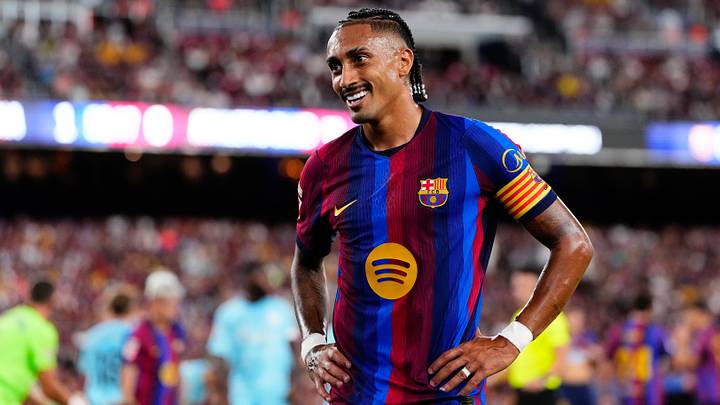
Even with all of Atletico Madrid's efforts to deny Barcelona the signing of Julian Alvarez, the Catalans don't even look the slightest bit interested in hitting the panic button. According to sources within the club, Hans Flick knows what he'll be doing if the Argentine doesn't arrive at Camp Nou before the closure of the transfer market.
Enter Raphinha.
Not a panic button solution
The practice of using a winger up front in the centre is generally born out of desperation when there's no one else available. But many within FC Barcelona maintain that this isn't a last-minute workaround. The intention, on the contrary, is that Raphinha will continue playing this role more as a choice of tactics within the high-intensity system Hans Flick implements.
The reason: his movement. Flick wants to see his team press from the front and operate with high rotation. Raphinha has work rate in abundance and has the tendency to come deep to collect the ball, dragging centre-backs into the midfield.
When you play Raphinha as centre-forward, he won't just wait for the ball, he'll drag centre-backs out of position and create vast areas of space, something that will be of great benefit to other teammates up front.
Feeding The Wingers
This fluidity in the forward line is also exactly what players like Karim Adeyemi, Anthony Gordon and Fermin Lopez require. The abundance of pace and directness from these three is well suited to a system that wants to attack space.
When Raphinha draws the attention of a centre-back out wide, players like Gordon or Adeyemi can get into the vacated space, running diagonally at defenders with pace.
Obviously, signing a pure striker such as Alvarez remains the main goal for Deco and the rest of the board, but should that not be achievable, they will not hesitate to rely on the reinvention of Raphinha in the front line.
 Add us as a preferred source on Google