

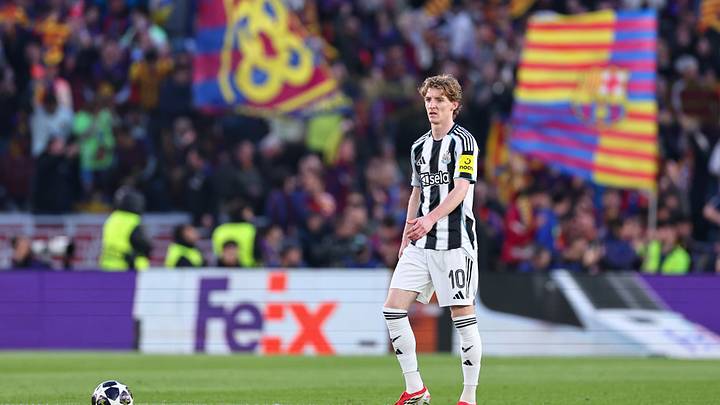
Anthony Gordon stood on the Camp Nou turf on 18 May, humiliated and embarrassed after a crushing 7–2 defeat at the hands of Barcelona, who swept into the next round of the Champions League.
Little did he know that the stadium would soon become his new home. Perhaps when he crossed paths with Hansi Flick on the touchline that evening, he was unknowingly being assessed for a place in Barcelona’s plans for the 2026/27 season.
The English forward will return from the World Cup as a Barcelona player, likely with a clearer understanding of the role he is expected to play next season. His focus will then shift to settling into his new surroundings and making a positive first impression on the Camp Nou faithful.
We examine whether Gordon will fit into Flick’s system next season.
Left Wing
Gordon’s most natural role is on the left wing and he faces his biggest competition in that position in the form of Raphinha.
His game is built around pace, directness and relentless movement from the left flank. He thrives when attacking open space, frequently making runs beyond the defensive line and stretching opponents vertically. That profile could add a different dimension to Barcelona's attack, particularly by creating room for teammates in central areas, where Raphinha could be deployed if accommodating the two.
At Newcastle, Gordon often found himself isolated against defenders, allowing him to use his speed and dribbling ability in one-on-one situations before cutting in on his favoured right foot. Barcelona's technical midfielders could help recreate those opportunities through quick passing combinations and switches of play.
Equally important is his work without the ball. Gordon possesses the energy and intensity required for a demanding pressing system, making him well-suited to the high-tempo style and defensive commitment expected under Hansi Flick.
Striker
The role is one in which he can establish himself within the team without encroaching on the status of Barcelona’s established stars.
Following Robert Lewandowski’s departure, the Englishman could fill the vacancy while adding a different dimension to the attack through his ability to run in behind defences. His versatility would also allow the front three to rotate positions and responsibilities more freely, creating a fluid and unpredictable attacking structure.
Although Gordon is not a traditional centre-forward, Newcastle United deployed him centrally on several occasions last season with encouraging results. Across 16 appearances as a striker, he recorded nine goals and one assist, but the significance lies less in the numbers and more in how the role suited his attributes.
Such an approach would mirror the systems previously used by Manchester City and Paris Saint-Germain, both of whom enjoyed success for extended periods without relying on a recognised out-and-out striker.
Attacking midfielder
This is arguably the position in which Gordon would face the greatest competition and have the least impact.
Deployed as part of an ultra-attacking front four, with a central striker ahead of midfield and wide forwards stretching the pitch, Barcelona would risk sacrificing the structure that has traditionally underpinned their success and expose their backline even more.
Such a setup would create a chaotic attacking environment, relying heavily on individual chemistry and instinctive movement rather than positional discipline. Instead of controlling matches through possession and organisation, Barcelona would be encouraging transitional football, with multiple attackers looking to exploit space at the same time.
Fielding Gordon alongside Raphinha, Lamine Yamal and either Ferran Torres or Julián Álvarez in advanced roles would place enormous pressure on the midfield to manage defensive transitions whenever possession is lost.
That responsibility would inevitably fall on Pedri, forcing him into a more defensive and physically demanding role. While capable of adapting, it would take him away from the creative freedom and game-controlling qualities that make him one of Barcelona's most influential players. We don’t vote for this formation.
 Add us as a preferred source on Google